Global recognition for African artists has often arrived late, filtered through Western institutions that decide whose stories matter and whose do not. That is why Ibrahim Mahama’s rise to the very top of the global art world is more than a personal achievement. For Ghanaian and African art, it represents a rare moment of visibility shaped on African terms.
Mahama’s work—built from discarded materials, collective labour, and histories of trade and exploitation—forces the global art establishment to confront narratives it has long ignored. His recognition is not simply about aesthetic success; it is about who controls cultural memory, whose labour is seen, and how African creativity is valued in the contemporary world.

From Tamale to Venice, and now to the pinnacle of international influence, Mahama’s journey invites a deeper question: what does this moment mean for Ghanaian art, African cultural institutions, and the future of creative ownership on the continent?
Who is Ibrahim Mahama?
Born in 1987 in Tamale, Ghana, Ibrahim Mahama grew up surrounded by the textures, colors, and rhythms of northern Ghana. From an early age, he observed how everyday materials—sacks, fabrics, and other discarded objects—were repurposed creatively in daily life. This environment shaped his sensibility for transforming the ordinary into culturally resonant art.
He attended the Kwame Nkrumah University of Science and Technology (KNUST), where his work began to explore collaboration and community engagement. Mahama’s formative years as an artist were deeply intertwined with local knowledge, labor practices, and historical narratives, giving his later work a distinctly African perspective often absent in global art discourse.
The Art and Its Meaning

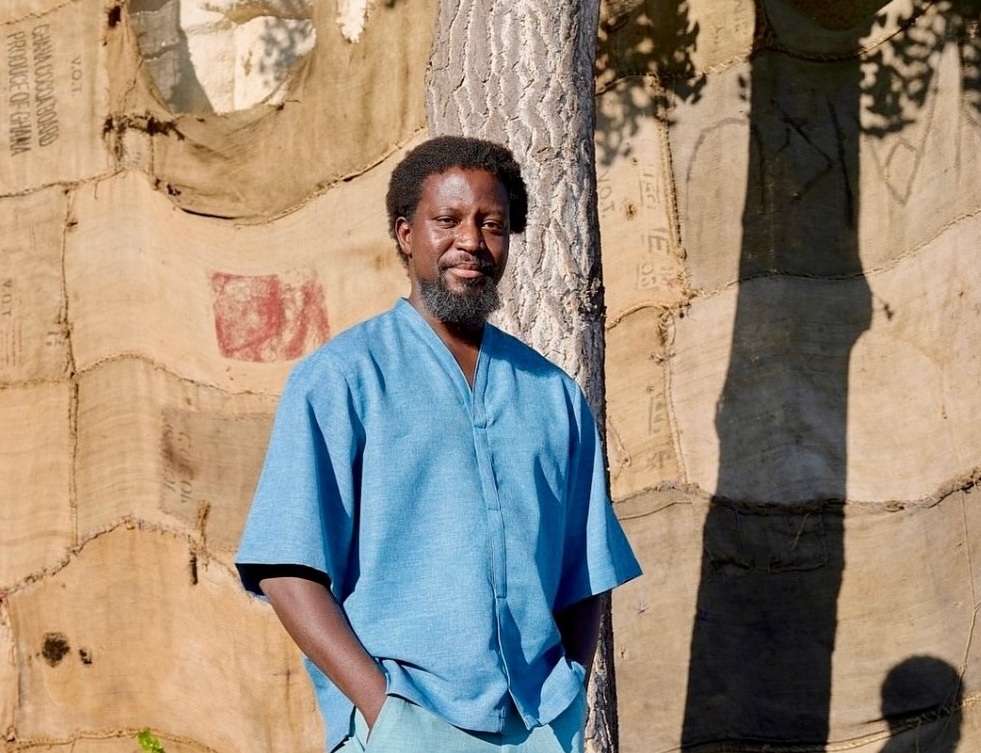
Mahama is best known for his monumental burlap sack installations, which repurpose jute sacks originally used for Ghana’s cocoa, coal, or other commodities. These materials, stitched and hung in galleries, carry stories of trade, labor, and postcolonial economic systems.
Beyond aesthetics, Mahama’s work interrogates global inequities, colonial legacies, and the often-invisible labor behind commodities. His art also embodies a philosophy of collective creation, involving teams of local makers in producing these large-scale installations.
“This work is about seeing what is usually unseen,” Mahama has said. For African artists, it is also about reclaiming narrative space in an art world historically dominated by Western perspectives.
From Local to Global
Mahama first gained international attention in 2015 with his installation Out of Bounds at the Venice Biennale. Over the years, he has exhibited across Europe, North America, and Africa, culminating in ArtReview naming him the most influential figure in the contemporary art world in 2025—the first African to hold that distinction.
This recognition is historic. It not only celebrates Mahama’s artistry but also signals a shift in global art institutions’ perception of African art. His voice now carries authority in spaces that were previously closed to African creators.
Building Institutions and Supporting Ghanaian Artists
Mahama’s impact extends beyond the gallery. He has created and nurtured institutions in Tamale that support emerging artists, including:
-
Savannah Centre for Contemporary Arts (SCCA)
-
Red Clay Studio
-
Nkrumah Volini
These spaces offer residencies, exhibitions, and educational programs, strengthening Ghanaian art infrastructure and enabling artists to develop sustainably within their own context.
As a history teacher, observing Mahama’s approach is inspiring—it demonstrates how cultural leadership can combine creative excellence with tangible social impact.
Read Also: Christmas in Ghana: How the Festive Season Was Celebrated Then vs Now
Cultural and Historical Context

Mahama’s work is deeply rooted in Ghanaian history and African postcolonial experience. By using materials tied to trade and labor, he highlights the continuing legacies of colonial commerce and global economic structures. His installations are not just objects—they are conversations with history, memory, and identity.
This context also situates Ghanaian art within a broader African narrative, challenging global audiences to rethink how African creativity has been historically marginalized or appropriated.
What This Means for African Creativity
Mahama’s success has broad implications:
-
Visibility – African artists now occupy influential global platforms.
-
Agency – His institutions show that African creatives can build infrastructure to define their own narratives.
-
Inspiration – Emerging artists in Ghana and beyond can see a pathway to global recognition without abandoning local context.
-
Cultural Leadership – Mahama demonstrates that creativity can be a tool for social transformation, historical reckoning, and institutional change.
Conclusion
Ibrahim Mahama’s journey—from Tamale to the summit of global art influence—represents a new chapter for Ghanaian and African art. It is a moment of pride, a call to invest in local creativity, and a reminder that African stories deserve to be told on their own terms.
As his influence grows, one question remains: How will this moment shape the next generation of African artists, and how will the world respond to an Africa confidently telling its own cultural story?
